
Quick Accesses
Menu
Quick Accesses
Início / Educação Básica
Presentation
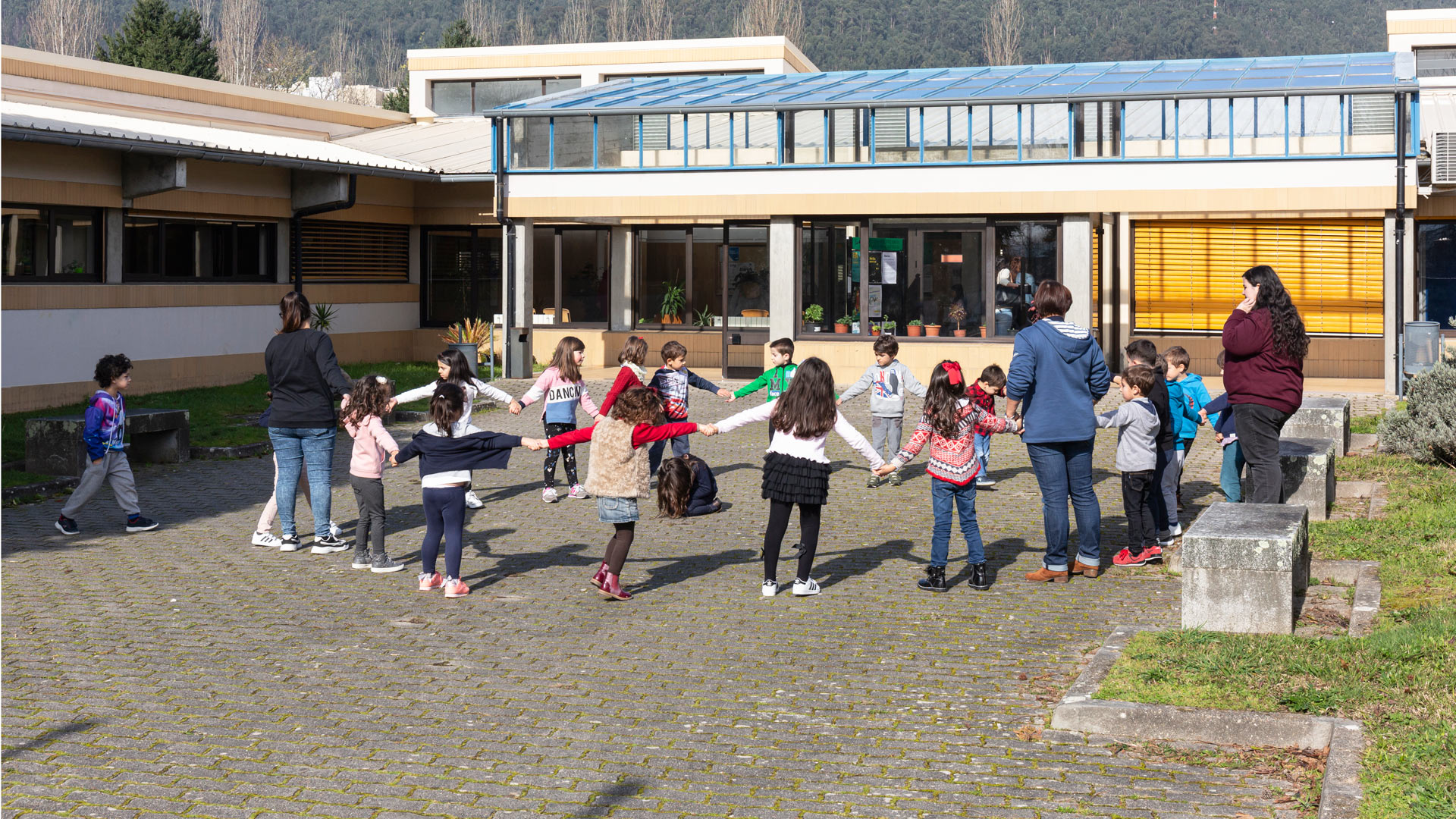
The Bachelor’s Degree in Basic Education, established by Ordinance No. 1419/2007, of 30 October 2007, began in the 2007/08 academic year and replaced the Early Childhood Education and Primary School Teacher programmes. According to the new Teacher Qualification regulations (Decree-Law No. 79/2014, of 14 May), the training of Early Childhood Educators and Primary School Teachers (all areas) and Middle School Teachers (Maths and Natural Sciences or Portuguese and History and Geography of Portugal) will now proceed through two mandatory cycles: The first cycle corresponds to the Bachelor’s Degree in Basic Education lasting three years (six semesters); the second cycle (Master’s Degree) will confer professional qualifications for teaching, where each student will select their specialisation:
Course comisssion
Access
Entry Requirements
Entrance Exams:
One of the following combinations:
[17] Mathematics Applied to the Social Sciences
[18] Portuguese
or
[16] Mathematics
[18] Portuguese
or
[19] Mathematics A
[18] Portuguese
Special Admissions
– Portuguese Diplomatic Mission Abroad
– Portuguese Grant Holders Abroad or Civil Servants on an Official Mission Abroad
– Officers of the Portuguese Armed Forces
– PALOP grant holders
– Accredited Foreign Diplomatic Mission in Portugal
– High Performance Sports Practitioners
– East-Timor Citizens
Special Entry Routes
Re-entry, Change of Combination/Institution/Course
Goals
Aims
General objectives
Specific objectives:
To prepare professionals who:
Graduate profile
The training profile of graduates in basic education is clearly defined by Decree-Law No. 79/2014.
Therefore, the curriculum design of this degree is based on the following training components: teaching areas (Portuguese, Mathematics, Natural Sciences and History and Geography of Portugal, Arts and Crafts); general educational area; specific didactics; cultural, social and ethical areas; and introduction to professional practice.
Professional outcomes
Continuing Studies
According to the new Teacher Qualification regulations (Decree-Law No. 79/2014, of 14 May), the training of Early Childhood Educators and Primary School Teachers (all areas) and Middle School Teachers (Maths and Natural Sciences or Portuguese and History and Geography of Portugal) will now proceed through two mandatory cycles:
Study Plan
| Curricular Unit | Area | Type | Contact hours | ECTS | PUC |
|---|---|---|---|---|---|
| Physics and Nature Science I | EFP | A | TP:46.00 | PL:18.00 | 6.00 | Consult |
| Elements of Mathematics | EFP | A | TP:96.00 | 8.00 | Consult |
| Oral and Written Communication | ADH | A | TP:64.00 | 6.00 | Consult |
| Social Studies | CPS | S1 | TP:48.00 | 5.00 | Consult |
| Psycology of Development and Learning | CPS | S1 | T:16.00 | TP:32.00 | 5.00 | Consult |
| Motor Development | CDTL | S1 | TP:20.00 | TC:12.00 | 4.00 | Consult |
| Práticas Artísticas I | ADH | S1 | TP:64.00 | 6.00 | Consult |
| Práticas Artísticas II | ADH | S2 | TP:64.00 | 6.00 | Consult |
| Education Investigation | EFP | S2 | TP:32.00 | 3.00 | Consult |
| History and Geography of Portugal | EFP | S2 | TP:48.00 | 5.00 | Consult |
| Professional Practice I | EFP | S2 | TP:22.00 | E:10.00 | 3.00 | Consult |
| Mathematics Workshop for Basic Education (optional) | EFP | S2 | TP:32.00 | 3.00 | Consult |
| Literary Education Workshop (optional) | EFP | S2 | TP:32.00 | 3.00 | Consult |
| Science Workshop (optional) | EFP | S2 | TP:32.00 | 3.00 | Consult |
| Cultural Heritage and Memory (optional) | EFP | S2 | TP:32.00 | 3.00 | Consult |
| Curricular Unit | Area | Type | Contact hours | ECTS | PUC |
|---|---|---|---|---|---|
| Physical-Motor Education | CDTL | A | T:10.00 | TP:54.00 | 6.00 | Consult |
| Physics-Nature Science II | EFP | A | TP:72.00 | PL:24.00 | 8.00 | Consult |
| Modern and Contemporary History of Portugal | EFP | A | TP:64.00 | 6.00 | Consult |
| Children's Literature | ADH | A | TP:64.00 | 6.00 | Consult |
| Grammar of the Portuguese Language | EFP | A | TP:64.00 | 6.00 | Consult |
| Professional Practice II | EFP | A | TP:40.00 | E:24.00 | OT:2.00 | 6.00 | Consult |
| Curriculum Development and Assessment | EFP | S1 | TP:48.00 | 4.00 | Consult |
| Geometry | EFP | S1 | TP:64.00 | 7.00 | Consult |
| Elementary Theory of Numbers | EFP | S2 | TP:64.00 | 6.00 | Consult |
| Aspects of psycho Inclusion | EFP | S2 | TP:32.00 | 3.00 | Consult |
| Techniques of Artistic and Cultural Management (optional) | ADH | S2 | TP:32.00 | 2.00 | Consult |
| Dramatic Expression (optional) | ADH | S2 | TP:32.00 | 2.00 | Consult |
| Jogo e Atividade Lúdico-Motora (opcional) | EFP | S2 | TP:32.00 | 2.00 | Consult |
| Curricular Unit | Area | Type | Contact hours | ECTS | PUC |
|---|---|---|---|---|---|
| Professional Practice III | EFP | A | TP:42.00 | E:54.00 | OT:4.00 | 10.00 | Consult |
| Integrated Mathematics | EFP | S1 | TP:48.00 | 4.00 | Consult |
| Literatures of Portuguese Language | ADH | S1 | TP:64.00 | 6.00 | Consult |
| Didática do Meio Social | EFP | S1 | TP:32.00 | 3.00 | Consult |
| Didática das Ciências | EFP | S1 | TP:16.00 | PL:16.00 | 3.00 | Consult |
| Didática das Expressões | EFP | S1 | TP:32.00 | 3.00 | Consult |
| Arts Pedagogy and Critical Citizenship | ADH | S1 | TP:16.00 | PL:16.00 | 3.00 | Consult |
| Educational Organisation and Management | EFP | S1 | TP:32.00 | 3.00 | Consult |
| Technology in Mathematics Education | EFP | S2 | TP:12.00 | PL:36.00 | 5.00 | Consult |
| Literatura e Língua: teorias e práticas | ADH | S2 | TP:64.00 | 6.00 | Consult |
| Didática do Português | EFP | S2 | TP:48.00 | 4.00 | Consult |
| Didática da Matemática | EFP | S2 | TP:48.00 | 4.00 | Consult |
| Artistic Planning Projects | EFP | S2 | TP:32.00 | 3.00 | Consult |
| Digital Literacy in Portuguese for Basic Education (optional) | EFP | S2 | TP:32.00 | 3.00 | Consult |
| Digital Literacy in Portuguese for Basic Education (optional) | EFP | S2 | TP:32.00 | 3.00 | Consult |
| Education for Health and Environment (optional) | EFP | S2 | TP:32.00 | 3.00 | Consult |
| History, Archives and Museology (optional) | EFP | S2 | TP:32.00 | 3.00 | Consult |
Employability
Employability
98.6%
More information from infocursos: http://infocursos.mec.pt/dges.asp?code=3162&codc=9853
Partnerships and internships
Beyond the partnerships established in the scope of projects associated with the course, it is worth highlighting a wide range of partnership agreements with educational institutions that welcome and mentor the students of the course, particularly in the Curricular Units of Professional Practice Initiation (IPP). These partnerships expand opportunities for training within a professional practice setting.
In the course curriculum design, emphasis was placed on distributing the training in the IPP component across the three curricular years (IPP1, IPP2 and IPP3) and to consider formal educational contexts at the pre-school education level and in primary and lower middle school (IPP2 and IPP3), as well as a variety of non-formal educational contexts (IPP1).
Other information
Course Prizes
Merit awards are given annually to:
Qualifying Work Experience:
In line with current legislation, prior professional experience of students in the course area may be valued for accreditation (if applicable). Moreover, for students coming from some CTeSPs (Higher Professional Technical Courses) at the ESE-IPVC in the education field, there are specific equivalence plans already approved by the IPVC Scientific and Technical Council.
Projects
Accreditation and Registration
Accreditation in 2020, for six years | Vacancy Limit: 64
Initial Registration: R/A-Ef 671/2011 of 18/03/2011
Amendment Registration:
R/A-Ef 671/2011/AL01 of 10/09/2014 | R/A-Ef 671/2011/AL02 of 19/02/2015
More information from the Agency for Assessment and Accreditation of Higher Education-A3ES: https://www.a3es.pt/pt/resultados-acreditacao/educacao-basica-74
General Information
180 ECTS | 6 Semesters | CNAEF 144 Training of Basic Education Teachers (1st and 2nd cycles) | Code: 9853
Qualification: Bachelor’s Degree